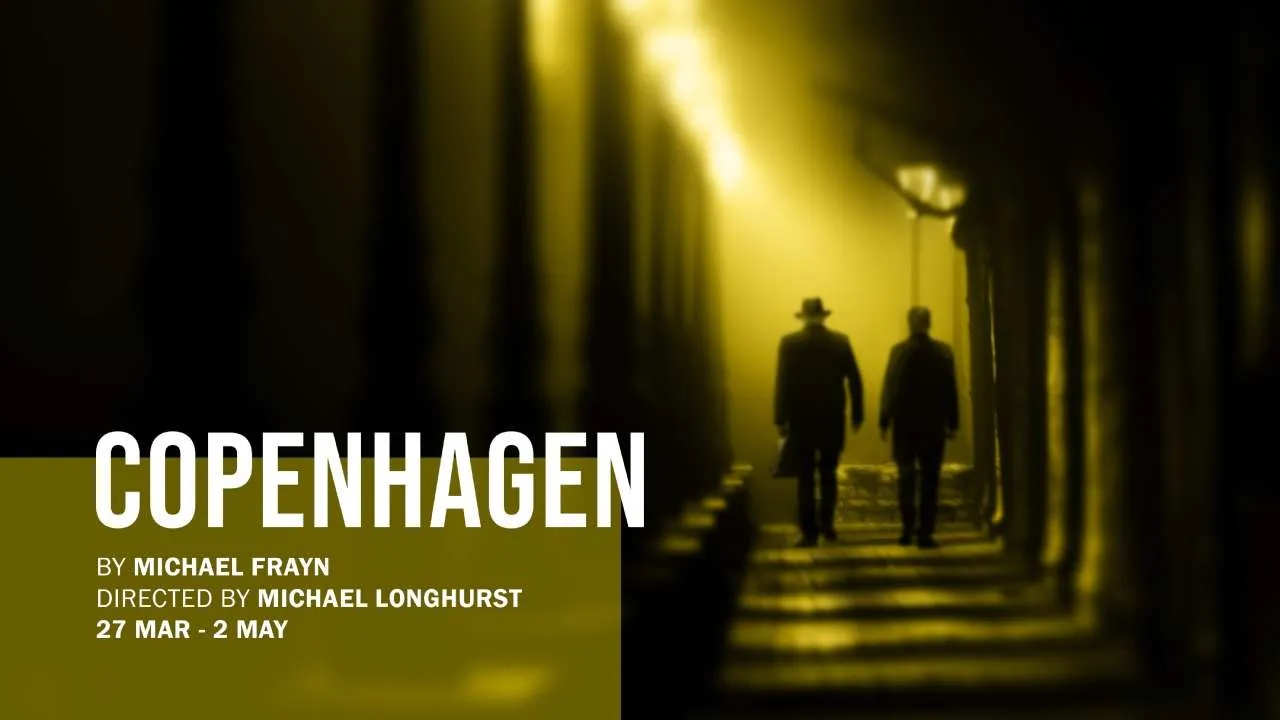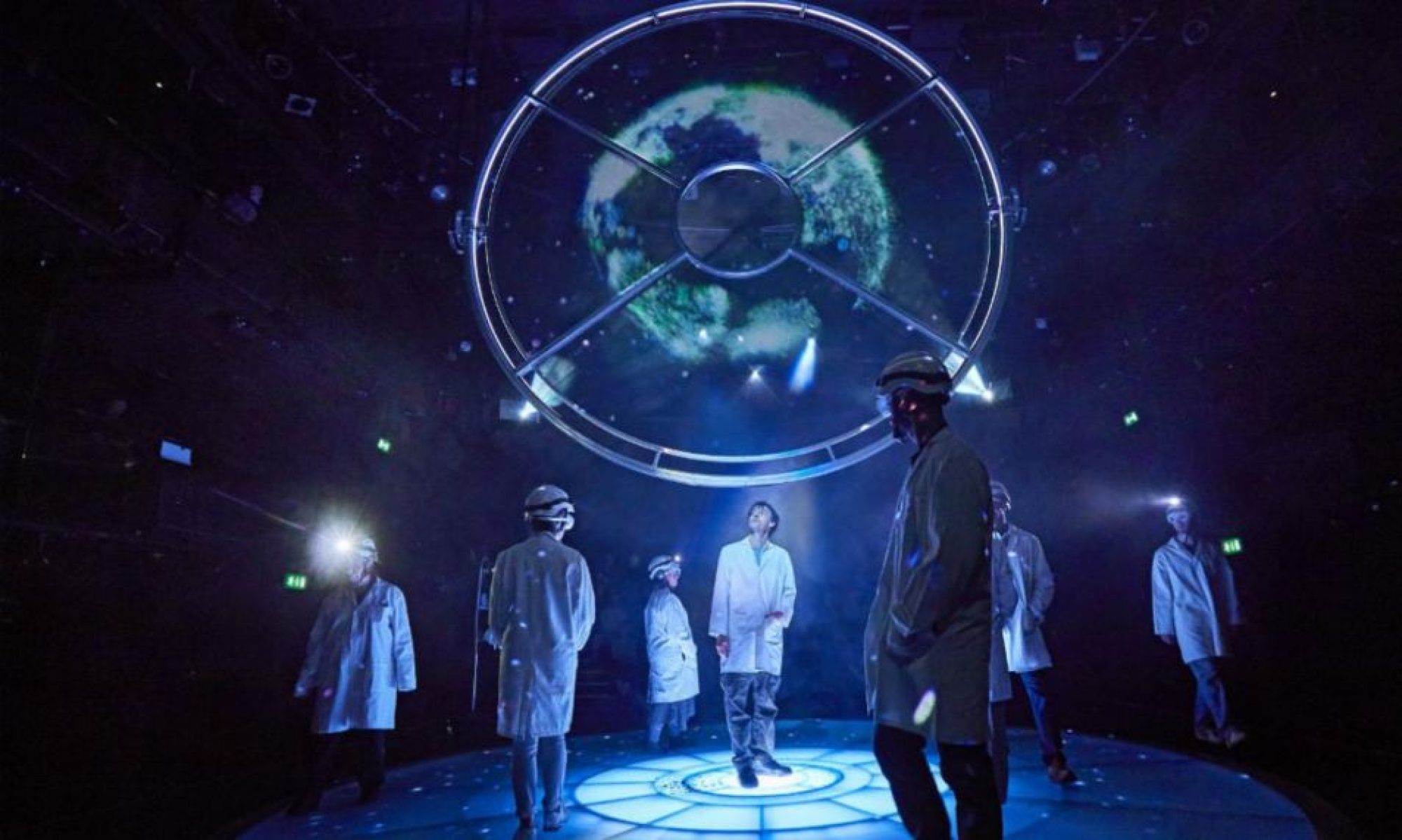
Hampstead Theatre will be producing Michael Frayn’s Copenhagen from 27th March 2026. This is this first London production since the original in 1998 and the first major UK revival since Micheal Blakemore directed in Chichester in 2018.
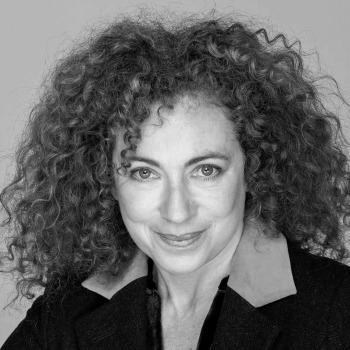
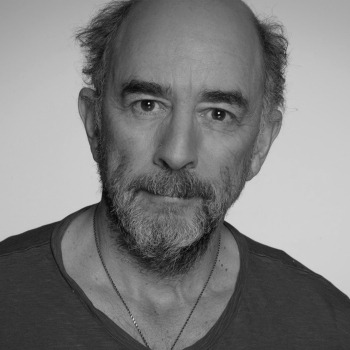
Michael Longhurst directs, no stranger to Science in Theatre. Richard Schiff and Alex Kingston will play Niels and Margrethe Bohr respectively. Casting for Heisenberg is yet to be announced. Copenhagen will run until 2nd May 2026. Tickets.
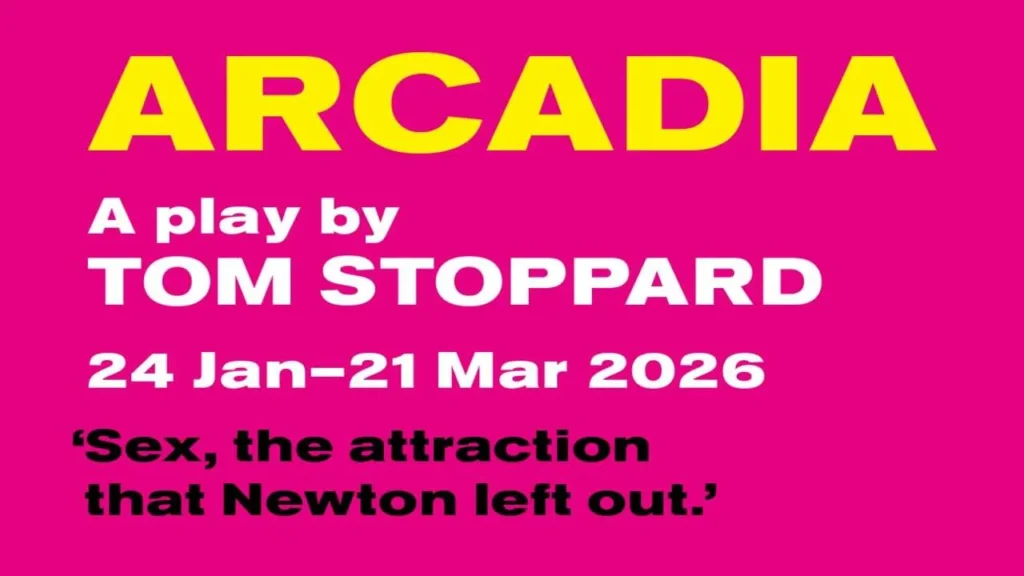
Casting has been announced for The Old Vic’s upcoming production of Tom Stoppard’s Arcadia, directed by Carrie Cracknell. Seamus Dillane and Isis Hainsworth will play Septimus and Thomasina respectively, with Leila Farzad and Prasanna Puwanarajah playing Hannah Jarvis and Bernard Nightingale in the 20th Century scenes.
The play will preview from 24th January, running until the 21st March 2026.
Tickets are available from The Old Vic Box Office.
A special welcome if you are here as part of the Theatre About Science International Conference 2025. Science Centre Stage hosts a collection of science plays and productions. Browse a list of science plays and click on the titles for an archive of past productions and flyers. Browse the blog for news and interviews with creatives. Use the menu above to browse by scientific topic or category of play. Find out more about Science Centre Stage and please get in touch .
I can't remember which side I'm supposed to be working for, and it is not in fact necessary for me to know.
The Cold War is approaching its endgame and somebody in spymaster Elizabeth Hapgood's network is leaking secrets. Is her star double agent really a triple? the trap she sets becomes a hall of mirrors in which betrayal is personal and treachery a trick of the light.
The Earthworks by Tom Morton Smith takes place in a hotel in Geneva on the eve of the switch on of the Large Hadron Collider.
‘Two strangers – a journalist and a scientist – share their experience of loss and hope in a funny but deeply touching one-act play.’ -Playtext published by Oberon Books.
First performed at the RSC Mischief Festival at Stratford-upon-Avon in May 2017.
You’re one of those ‘because the sun’s going to expand and swallow the earth in four billion years…everything is therefore meaningless’ kind of people. Leave the Ladybird Book of Nihilism on the shelf and tell me something real.
‘The Uncertainty Principle’ is the subtitle of Simon Stephens’ new play Heisenberg, currently running at Wyndham’s Theatre in London. But this is not the only time the principle has been explored on stage during 2017…
Kenneth Cranham and Anne-Marie Duff in Heisenberg: the uncertainty principle at Wyndham’s Theatre
Much like Simon Stephens’ other new play this year, Nuclear War, the title of Heisenberg: The Uncertainty Principle is not particularly indicative of the content. Heisenberg is a touching romantic comedy in which the uncertainty principle makes only the loosest of appearances. This presents no difficulty in itself – artists are of course entirely entitled to use whatever ideas they choose as a title for their work. However, perhaps it indicates something about the cultural climate in 2017 that producers can confidently borrow an otherwise esoteric scientific concept to market a main stream West End production.
Simon Rouse as The Professor in Insignificance at the Arcola Theatre. Photo: Alex Brenner
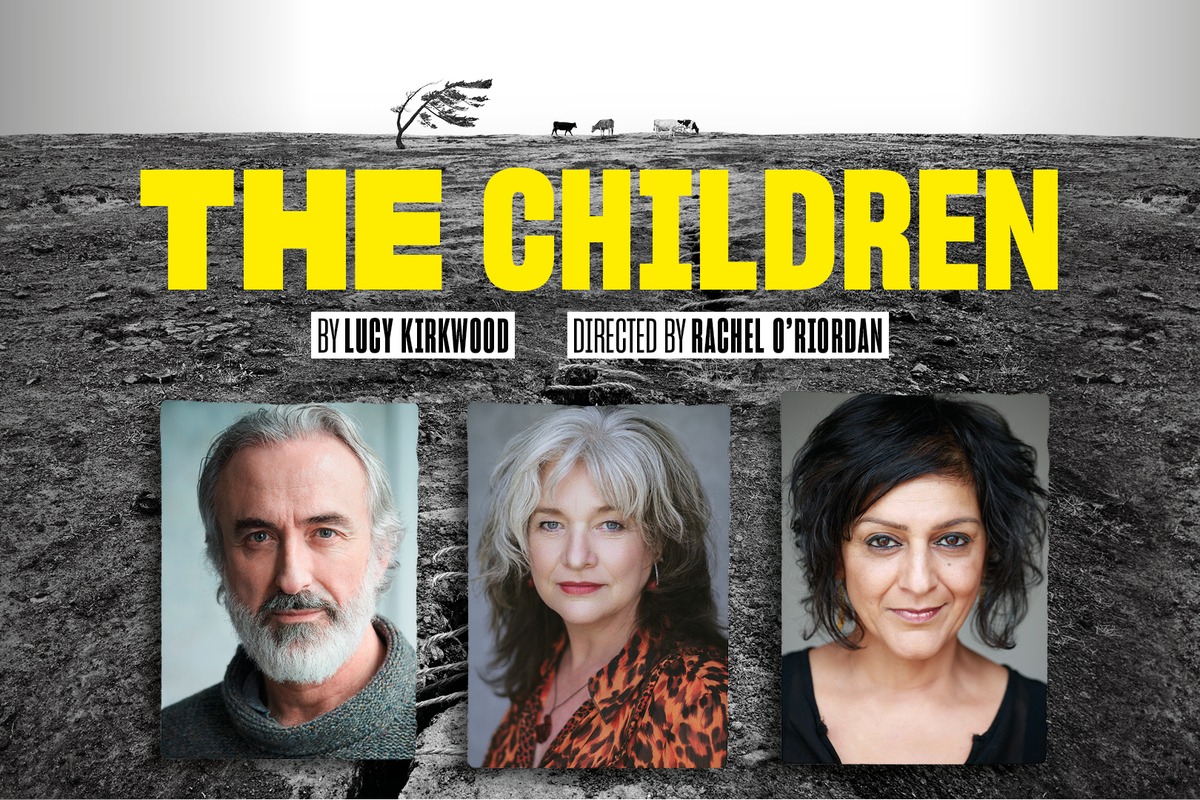
The Royal Court Theatre, which produced Stephens’ Nuclear War, also premiered Lucy Kirkwood’s new work The Children earlier in the year. This was a dark and reflective piece about the legacy of three retired nuclear scientists of the baby boomer generation. As thoughtful as The Children was, it was surely Lucy Kirkwood’s other major new work Mosquitoes at the National Theatre that was arguably the piece of standout science theatre in 2017.
Mosquitoes is set at the time of the switch-on of the Large Hadron Collider (LHC) at CERN in 2008. A play that includes a character called ‘The Boson’ immediately rings alarm bells over the risk of didactic dialogue and some superficially inserted science. Far from it, Mosquitoes delivered an absorbing and funny family drama with complex three-dimensional characters that we come to care deeply about. The scientific setting sits very comfortably within the play, complementing but not dominating the narrative. It is the tale of two sisters, Alice – a staff scientist at CERN (played by Olivia Williams) – and Jenny, her troubled and arguably naïve sister (Olivia Colman). Contrary to Alice’s high minded approach, Jenny has developed her own brand of tabloid-style scepticism and fact-free opinion that results in difficult consequences for her and her family. As a politician famously once said, ‘people in this country have had enough of experts’.
A scene from Mosquitoes at the National Theatre. Photo: Brinkhoff Mogenburg
Mosquitoes also features two relatable teenage characters who are grappling with their sense of place – both literal place (displaced from England to Geneva) and virtual (negotiating the brave new Snapchat world). What Kirkwood and director Rufus Norris achieved with Mosquitoes is the rare combination of a full length two-act play that draws heavily on science and yet comfortably stands alone as an enjoyable, relevant and probing piece of theatre.
It is the character of the sisters’ mother Karen (Amanda Boxer), a retired Cambridge scientist herself, who brings up the uncertainty principle in the form a joke told to her daughter (partially to alienate Colman’s less science-savvy character). The principle (and the joke) is never overtly explained for the benefit of the audience. If we are also to feel alienated rather than enlightened is something that we are left to decide for ourselves, much to the credit of the writer.
Alice Bailey Johnson as The Actress in Insignificance. Photo: Alex Brenner
Mosquitoes was not the only new play this year set around the opening of the LHC. The Royal Shakespeare company took this on as part of their Mischief Festival in the spring when Tom Morton-Smith (Oppenheimer 2015) delivered a one-act piece for ‘The Other Place’ studio theatre in Stratford-upon-Avon. The Earthworks charts an encounter between a science journalist and a postdoc researcher, also on the eve of the LHC switch-on. It’s a very neat little piece (on a similarly human scale to some of Nick Payne’s one act plays) with some fun science inserted (at one point non-Newtonian fluids are demonstrated live on stage with custard borrowed from the kitchen of an up-market hotel). The Earthworks offers a valuable new perspective that other ‘science plays’ have not yet really approached – a sense of the potential conflict between the need for click-friendly news nuggets to sustain modern online media and the more considered, often-long term nature of scientific research. There was plenty of great material to work with here and The Earthworks adds a great deal to the genre. However, towards the end of the play, real science is conflated with (albeit plausible) science fiction. This worked well to advance the narrative in a moving way, but it felt slightly disappointing to mix fact and (near) fiction in the same piece given that there is already so much great real science in the play.
Olivia Coleman in Mosquitoes. Photo: Brinkhoff Mogenburg
The confusion of fact and fiction is central to Terry Johnson’s 1982 play Insignificance, currently enjoying a revival at The Arcola Theatre in Dalston. The Professor, The Actress, The Senator and The Ball Player all meet in a fantasy encounter in a 1950s Manhattan hotel room. The contrivance works because the characters (although never named) are of course Albert Einstein, Marilyn Monroe, Joe McCarthy and Jo DiMaggio. It’s a fun and at times sinister piece with some great casting by director David Mercatali. The gentle Einstein (Simon Rouse), a flighty but vulnerable Monroe (Alice Bailey Johnson) and an oafish DiMaggio (Oliver Hembrough) spar and with each other and with the ruthless Senator McCarthy (Tom Mannio). Since Einstein is in nearly every scene it comes as no surprise that science makes an appearance. However it is in fact Monroe who gives a breathless and accurate summary of the principles of special relativity to The Professor in the first act, before the play goes on to explore some its darker themes.
Kenneth Cranham and Anne-Marie Duff in Heisenberg: the uncertainty principle. Photo: Elliot and Harper
Shortly before the end of Insignificance Einstein makes a passing reference to the uncertainty principle. It drew a muffled but knowing response from members of the audience, who were perhaps conscious that this is not the only ticket in town with a bit of exposure to this particular piece of science.
It was of course nearly 20 years ago that Michael Frayn so successfully wove the uncertainty principle seamlessly into the structure of Copenhagen at the National Theatre. It seems almost churlish to note here that none of the recent productions discussed above manage to replicate that sophistication. However, the prevalence of the uncertainty principle in 2017 demonstrates that audiences are increasingly comfortable to engage with science in a theatrical setting. And that seems to be one principle worth pursuing.
Insignificance runs at the Arcola Theatre until 18th November 2017
The semantics of an argument between a senior and junior doctor form the basis of Blue/Orange, Joe Penhall’s play about a young black man who has been confined in a psychiatric ward. Matthew Xia directs a revival of Blue/Orange at the Young Vic Theatre between 12th May and 2nd July, with Daniel Kaluuya, David Haig and Luke Norris in the cast.
Science Centre Stage spoke to Matthew Xia about the process of staging this revival in the current climate of change in the NHS, about using words to create illusion and misdirection and the current place of medicine in theatre.
Can you give a little background to Blue/Orange and what it is about?
Matthew Xia directs Blue/Orange at the Young Vic. Photo: Johan Persson
Blue/Orange was written towards the end of the late nineties by Joe Penhall in what was at the time his most successful play. It won the Olivier Award for Best New Play in 2000. The original production at the National Theatre starred Bill Nighy, Andrew Lincoln and Chiwetel Ejiofor. Sixteen years later we want to explore the same themes which feel ever more pertinent. There’s certainly a series of crises concerning junior doctors and beds and resources and all the things that have constantly plagued the NHS.
We start on Day 27 of a Section for a young black man called Christopher. He’s in for assessment and treatment over a course of 28 days. He’s on the 27th day, so he’s being released tomorrow. But the junior doctor, who is white, (Christopher is black) thinks that there is something in the diagnosis that is inaccurate and would like to have him stay for up to six months. In order to do that he needs the agreement of his senior consultant called Robert Smith. Ultimately the play is looking at the potentially subjective nature of diagnosis, particularly in psychiatry, and how that is affected by things such as unconscious bias, ethnocentricity, cultural specificity, and how these things cause us as humans to make subjective diagnoses, even with our best will and best intent in mind.
What the play really tries to tackle and what I’m personally interested in, is first, the kind of diametric argument that is presented. Joe Penhall’s great at writing complex, nuanced, detailed arguments. Secondly, you’ve got these two white doctors and their black patient so I guess the other thing that it really explores is the power structures inherent in patient-doctor dynamics and how that might have a bearing on diagnosis. It also explores the power structures within the relationship between a senior and a junior doctor and the expectations upon both of them in those roles.
Did you consult with doctors and psychiatrists during the development process to help understand the system they operate in?
Yes, certainly. My process anyway is to completely immerse myself in the world that the characters live in. The mental health guidelines from 1997, government documents, white papers, testimonials and a brilliant book called Users and Abusers of Psychiatry were really useful in the rehearsal room. The next stage was that the designer (Jeremy Herbert) and myself went along to the Maudsley Hospital. The play isn’t set in the Maudsley but it’s the crown jewel of mental health facilities. I went down there and spoke to occupational therapists who gave us a tour of the building so we started to get an idea of the environment that these people would be working in.
Luke Norris plays the junior doctor Bruce. Photo: Johan Persson
We met a brilliant man called Dr. Neil Brenner who is a consultant psychiatrist and had the most incredible array of stories and experiences. We’d read him small bits of the play and he’d respond to them, which gave us a sense of the truth of the world that we were trying to replicate and also some guidance on how far we could stray from the truth with the production.
How do you challenge without offending, upsetting or crossing the status boundary?
At at the turn of this century there was a very clear hierarchy [in medicine]. The junior doctor in this play is ideological and principled and that leads him to challenge his senior quite a lot. Dr. Neil Brenner says he would be out on his ear, immediately. It was useful because it actually meant we could temper some of those challenges. Then there is a much more interesting game to navigate. How do you challenge without offending, upsetting or crossing the status boundary? I think this makes for a much more interesting reading than a hot headed, fiery, junior doctor who doesn’t quite know his position.
Given that you were told Joe Penhall was something of a soothsayer for predicting future changes in the NHS back in 2000, do you think the play says anything about future patterns and how things might develop from here? Or is it more of a snapshot of where things are?
I think it’s more of a snapshot of where things are but I think that brilliant thing of putting a play on at a different time to when it was written means that it becomes a prism that refracts today’s thinking and understanding. You spot new patterns and different correlations that maybe weren’t so readily apparent the first time round. I think we live in a very different, much darker world than we did in 2000, a kind of post 9/11 world. Christopher thinks his father might be Idi Amin at one point – that’s ambiguous, and it’s meant to be ambiguous. Is his father Idi Amin or not? But he says at one point he’s a Muslim fundamentalist. Now in 2000 that would have rung out in such a different way to how it rings out now. This man being attracted to this hugely powerful Muslim extremist- it says something very different. So I guess my point is that the play has stayed the same. We have changed and it will be interesting to see how that relationship between audience and piece has changed because of the shift in society.
David Haig as senior consultant Robert Smith in Blue/Orange Photo: Johan Persson
Does your interest and background in illusion have any bearing on your work in theatre?
I think they are quite separate interests for me. My interest in illusion is an interest in amazing people and in small theatrical events and happenings. In my last show (Into the Woods) it was much easier to employ magic and trickery in a fairytale land. I think where the magic actually comes into Blue/Orange is that it’s ultimately a play about semantics and the inherent power of words and the slipperiness of words. Of course that was all coming out of people like Alastair Campbell and the Blairites – that was the world that this play was written in. Spin was huge. Somebody of a particular class or esteemed in a particular fashion could say something that meant one thing and if somebody else said it – it meant something completely different. It was a game of rhetoric. I think that’s the sort of magic that I’ve become interested in in the last ten years – the misdirection of words and the use of words to mask and create smoke and mirrors. That is almost certainly within the play. The character that David Haig plays is so manipulative and controlling and Machiavellian in the way that he uses his words. He’s incredibly calculating, incredibly deft with his deployment of words. I’ve always had that interest in magic and it’s something that’s come to the forefront more recently with psychological illusionists.
Given that you have quite a small cast, how does your rehearsal process work – do you like to work with the writer in the room?
I spent a lot of time with Joe in the casting of the show and very early on in rehearsal. He came in and pointed out where the pitfalls were to be found or the problematic spots or certain things that we just have to get right with this play otherwise is just doesn’t quite work in the way that it’s meant to. It’s incredibly useful, incredibly helpful. But I think as with all plays ultimately, even if it’s a new play, at some point the writer needs to leave having known that they’ve done their job, which is to write the play and to pass that over to a team who would then bring it to life. One of the problems with having a writer in the room too long is that everybody looks for direct answers. So as opposed to having an investigative exploratory process you just go ‘why do I say this?’ or ‘why does he do that?’ instead of working through your own system of logic as to why you get from one thought to the other. It’s been great having Joe so close to this production and equally it’s been great, as always, being left to our own devices to make a play.
Similarly with designers, do you bring your own ideas beforehand and work through it with them in rehearsal or do you leave it to them to approach you with ideas?
The reason that I make theatre and one of the reasons that I enjoy making theatre, is the collaborative nature of the arts. It’s very much me and Jeremy Herbert sat in a room reading the play very badly to each other and then finding what it needs, what it’s about, what moments have to be realized in terms of a pragmatic approach to the work, versus a more abstract conceptual approach.
It’s ultimately a play about semantics and the inherent power of words
The idea that Christopher is in an institution, what does that mean? One of the decisions that we made is Christopher never leaves the playing area so that you know he is here constantly and it is his life that’s being discussed and that he is completely disempowered in those conversations. And of course time and place is the ultimate thing that you are hoping to communicate to an audience with your design.
That then develops into a series of images, references, sketches and drawings. I might walk past a painting or a piece of skirting board or a colour and just take a picture and send it to Jeremy. There’s quite a protracted process where we’re always reluctant to put anything down too quickly. Then you start playing in a 3D world with a model box. I always knew this was the presentation of an argument and what we’re looking at under the microscope isn’t actually Christopher. We’re not as an audience trying to diagnose Christopher. That might be part of the game that you play as an audience member but what you’re really doing is trying to understand how these doctors are arriving at these diagnoses or theories and the words that they use to bolster and strengthen that and the understanding that they might not necessarily be doing it for absolutely Hippocratic reasons.
Do you think there has been a recent shift towards an increasing representation of science and medicine on stage or have these subjects always been ripe for exploration in theatre and the arts?
I don’t personally feel like there’s been a shift. I think theatre can only ever respond to the here and now and particularly in the writing of new plays. Would somebody say that Alistair McDowall’s X at the Royal Court is an exploration of science when it’s set on a space station in Pluto? Ultimately it’s about the breakdown caused by isolation and loneliness. A play about science is still a play about human experience and I think these questions have always been asked whatever the current thinking of the time was. You could argue that The Alchemist by Ben Jonson is a play about the modern contemporary science and understanding of how elements may work. You could argue that Doctor Faustus with his investigations into magic and the occult is an exploration of science.
I think people are finding more interesting ways of putting stories about scientists and physicians and medical practitioners and engineers on stage. That’s possibly got something more to do with a slightly liberated way of approaching theatre that isn’t so bound by dialogue, dialogue, dialogue, next scene, dialogue. People are playing with projection and elements and smells and sounds. Is Peter Brooke’s The Valley of Astonishment, exploring synesthesia a play about science? Or is it a play about human experience?
Or are they one and the same?
Matthew Xia’s production of Blue/Orange by Joe Penhall runs at the Young Vic 12 May – 2 July. Tickets www.youngvic.org 0207 922 2922
In a year in which high-profile productions such as Photograph 51 and Oppenheimer attracted considerable attention for bringing science to the stage, 2015 was also a year in which smaller gems such as Islington Community Theatre’s Brainstorm shone.
Nicole Kidman played Rosalind Franklin in Photograph 51. Photo: Marc Brenner
It was arguably the star appeal of Nicole Kidman rather than the play that drew audiences to the Noel Coward Theatre in September to see Anna Zeigler’s Photograph 51. However, those who saw Kidman’s portrayal of Rosalind Franklin (for which she received an Evening Standard Theatre Award for Best Actress) in Michael Grandage’s production saw a theatrical depiction of an intriguing period in the history of science. Science Centre Stage spoke to Edward Bennett, who played Nobel prize wining biophysicist Francis Crick in the production, about his approach to playing a real-life character and visiting the archives at Kings College London. Photograph 51 is currently nominated for best new play in the What’s On Stage Awards (despite first being performed in the USA in 2007).
When Tom Morton-Smith’s play Oppenheimer opened at the Royal Shakespeare Company’s Swan Theatre at the beginning of the year, its subsequent success was sufficient to lead to a West End transfer. Commuters in London encountered hundreds of posters featuring John Heffernan as J. Robert Oppenheimer promoting the play at the Vaudeville Theatre where it played for two months. The Institute of Physics and Graham Farmelo arranged a panel discussion at the RSC in Stratford-upon-Avon in which the playwright, director Angus Jackson, physicist Prof. Frank Close, science journalist Alok Jha and former Times literary editor Erica Wagner discussed the themes of the play in an event chaired by deputy artistic director of the RSC Erica Whyman.
Another panel discussion in May at the Royal Society, also chaired by Erica Whyman, saw Tom Morton-Smith discuss Oppenheimer with Prof. Marcus du Sautoy, Prof. John Barrow and science-theatre scholar Prof. Kirsten Shepherd-Barr (whose new book Theatre and Evolution from Ibsen to Beckett was published by Columbia University Press in 2015).
Although Oppenheimer and Photograph 51 offered the highest profile portrayals of scientists in mainstream theatre last year, there were also some very strong smaller scale performances bringing together science and theatre, particularly generated by collaborations between scientists, theatre makers and writers.
Brainstorm was developed by Islington Community Theatre with support from the Wellcome Trust
An undoubted highlight of 2015 was Brainstorm, Islington Community Theatre’s uplifting and energetic piece exploration of the neuroscience of the teenage brain. It was performed by 10 teenagers with support from the Wellcome Trust and was devised by the cast with guidance from UCL neuroscientists Prof. Sarah-Jayne Blakemore and Katie Mills and directed by Ned Glasier. A hugely successful opening run at the small Park Theatre in January led to a well-deserved transfer to the National Theatre’s temporary theatre space in the summer. Islington Community Theatre then took part in Battersea Arts Centre’s Live From Television Centre project, resulting in a 30-minute version of Brainstorm becoming available on BBC iPlayer, substantially widening the audience it reached. Brainstorm will return to the National Theatre in 2016.
Harry Lister Smith in Metta Theatre’s Mouthful Photo: Richard Davenport
Another intriguing production benefiting from Wellcome Trust support in 2015 was Metta Theatres’ Mouthful, in which international playwrights were paired with scientists to produce six short plays about the global food crisis. The result was a thought provoking and engaging production at London’s Trafalgar Studios. Science Centre Stage spoke to Metta Theatre’s artistic director Poppy Burton-Morgan about the development process behind Mouthful and how the scientists and writers worked together to create the plays.
Menagerie Theatre also continued their strong programme of pairing academics and writers in their What’s Up Doc? series for the 2015 Hotbed Festival in Cambridge. Pictures of You was writer Craig Baxter’s latest collaboration with Dr. Martina Di Simplicio of the MRC Cognition and Brain Sciences Unit at Cambridge University, in which mental imagery was explored in a short play that was subsequently had a short run at London’s Soho Theatre.
That Is All You Need To Know – Idle Motion
There was barely space to swing Alan Turing’s bicycle in the upstairs space at the Arts Theatre (though they tried) as The Hope Theatre’s performed Snoo Wilson’s Lovesong of the Electric Bear in a quirky and offbeat take on the life of Alan Turing directed by Matthew Parker. Meanwhile, Turing also featured in That Is All You Need To Know at the New Diorama Theatre as Idle Motion performed their Bletchley Park inspired piece of remarkable devised physical theatre for the last ever time.
At the peripheries of the science-theatre genre lie certain plays presenting dystopic but feasible near-future scenarios. In 2015 the Royal Court Theatre’s production of Jennifer Haley’s The Nether asked pressing questions about the boundaries between the online world and reality during a 12 week run at the Duke of York’s Theatre. The Young Vic Theatre played host to Southampton Nuffield’s revival of Caryl Churchill’s A Number, exploring the possible consequences of where human cloning could take us. Science Centre Stage spoke to director Michael Longhurst about the background to the play and how he and Tom Scutt worked together on the striking set design.
Nick Payne’s Constellations had a UK Tour in 2015
The inestimable Tom Stoppard topped and tailed the year with his new neuroscience-inspired play The Hard Problem opening at the National Theatre in January and a revival of the little-performed Hapgood at Hampstead Theatre in December. Hapgood is a spy-thriller drawing on ideas from quantum physics which apparently baffled many who saw the original production in 1988. However, Stoppard has revised the play several times since, including an updated version for the Hampstead Theatre that runs until 23rd January 2016.
The Hard Problem will have its USA premiere from 6th January 2016 at he Wilma Theatre in Philadelphia. Stoppard discussed the play with philosopher David Chalmers, who first coined the term the ‘hard problem’ to address the question of consciousness, on stage recently ahead of the new production.
January 2015 saw the death of scientist and playwright Carl Djerassi at the age of 91. Djerassi’s writing about the relationship between science and theatre was extensive and he wrote many plays, including Insufficiency and Oxygen (with Roald Hoffmann) each constructed around some aspect of science. Despite at times being controversial, and with mixed reactions to his plays, his approach was spirited and there is no doubt Djerassi contributed a great deal to the consideration of the place of science on the stage. Jenny Rohn wrote thoughtfully about her own interactions with Djerrassi in a piece for LabLit in March.
Lisa Dillon as Elizabeth Hapgood at the Hampstead Theatre until 23rd January
If 2015 was a strong year for science in theatre then 2016 also has some interesting prospects in store. A new play by Nick Payne for the Donmar Warehouse opens in April. The Royal Shakespeare Company will apply their considerable resources and talents to a new version of Christopher Marlowe’s Doctor Faustus, arguably one of the early depictions of a scientist in theatre. But if Photograph 51, Oppenheimer and The Hard Problem were some of the mainstream successes of 2015, it is the smaller gems that may also be most worth seeking out in 2016.